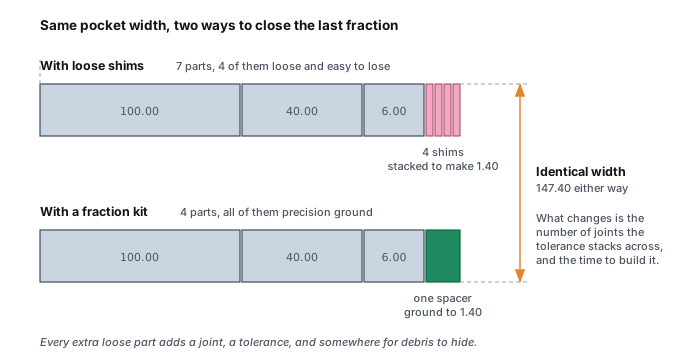
Shimless setup means hitting the exact pocket width with metal spacers alone, using no plastic shims at all. It is possible because of fraction kits: sets of thin metal spacers in 0.10 mm and 0.01 mm steps that let you build any width your job needs out of steel, instead of making up the last fraction of a millimetre with plastic.
That matters because the plastic is the least predictable part of the stack. Shims compress under clamping force, creep over a long run, and vary between batches, so the pocket you measured cold is not the pocket you are cutting with an hour later.
The Problem with Plastic Shims
Plastic shims typically range from 0.05mm to 0.5mm in thickness. While they're convenient for fine-tuning, they introduce several issues:
- Compression: Under arbor clamping force, plastic shims compress by 0.01-0.05mm, changing the effective pocket width during production
- Creep: Over extended runs, shims continue to deform, causing progressive width drift
- Temperature sensitivity: Shim thickness changes with arbor temperature, which rises during cutting
- Inconsistency: Shim thickness varies between manufacturers and even between batches
- Handling: Thin shims tear, fold, and jam during arbor loading
For operations targeting plus or minus 0.05mm width tolerance, these issues are not just theoretical. They are the direct cause of width variation and out-of-tolerance strips.
What Are Fraction Kit Spacers?
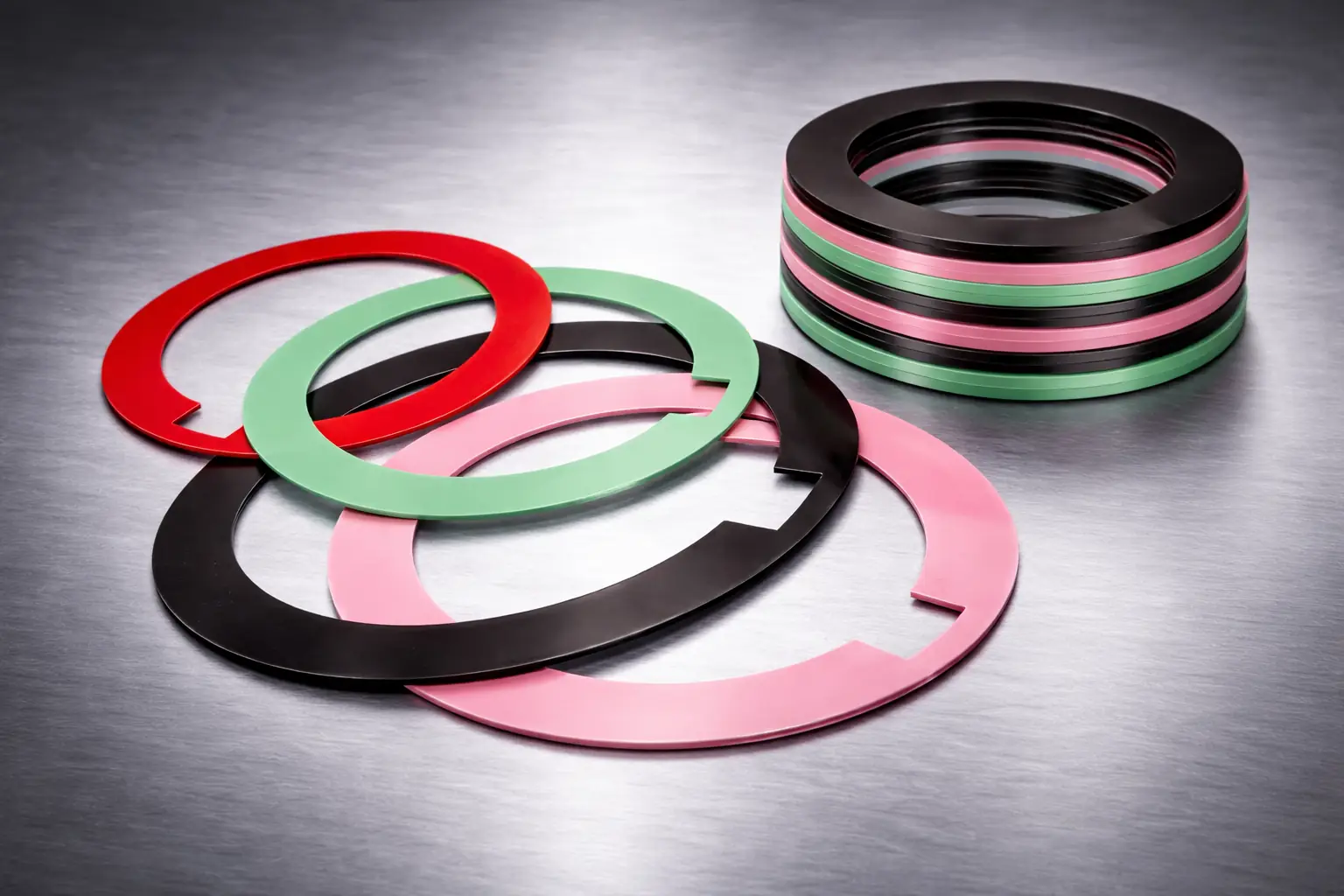
Fraction kits are precision-ground metal spacers in two resolution sets:
- F-0.10 set: Spacers at 0.10, 0.20, 0.30, 0.40, 0.50, 0.60, 0.70, 0.80, 0.90mm
- F-0.01 set: Spacers at 0.01, 0.02, 0.03, 0.04, 0.05, 0.06, 0.07, 0.08, 0.09mm
By combining standard spacers (whole millimeters) with F-0.10 spacers (tenths) and F-0.01 spacers (hundredths), you can build any pocket width to 0.01mm resolution using only metal parts.
For example, a pocket width of 127.73mm would be built as: 100 + 20 + 5 + 2 (standard) + 0.70 (F-0.10) + 0.03 (F-0.01) = 127.73mm exactly.
Why Shimless Is Better
| Factor | Plastic Shims | Fraction Kits |
|---|---|---|
| Material | Plastic / polymer | Hardened steel |
| Compression under load | 0.01-0.05mm | Negligible |
| Temperature stability | Poor | Excellent |
| Repeatability | ±0.02-0.05mm | ±0.005mm |
| Lifespan | Limited (wear, tear) | Thousands of setups |
| Setup complexity | Low (just slide in) | Moderate (need right combination) |
| Software support | Not needed | Recommended for efficient selection |
The Calculation Challenge
The reason plastic shims remained dominant for so long is simple: finding the right fraction kit combination manually is tedious. When you have standard spacers in 20+ widths and fraction kits in 18 sizes, the number of possible combinations per pocket is enormous.
This is exactly the problem OptiStack Pro's shimless solver was built to handle. The algorithm:
- First solves using standard metal spacers to get as close as possible
- Calculates the remaining gap (e.g., 0.73mm)
- Finds the optimal F-0.10 + F-0.01 combination (0.70 + 0.03)
- Verifies all parts are available in inventory with sufficient quantity
- Generates the complete load sequence for the shop floor
The entire process takes under 1 second.
When to Switch to Shimless
Shimless operation makes the most sense when:
- Your customers require ±0.05mm or tighter width tolerances
- You're experiencing width drift on long production runs
- You process materials where edge quality is critical (automotive, electrical steel)
- You're tired of plastic shims tearing, folding, or jamming during setup
- You want repeatable setups regardless of which operator is on shift
How to audit your own shim drift
Before you invest in a fraction kit, prove the problem exists on your line, because a measured before and after convinces a skeptical crew faster than any article. Pick a job you currently run with plastic shims and hold to a tight width. Measure a strip width at the start of the run, when the arbor is cold, and record it. Run the job normally, then measure the same strip position again near the end of the run, when the arbor is hot. On a shimmed pocket you will usually see the width creep by a few hundredths as the shims compress and warm, and the drift is worse the more shims are in the stack.
Now you have your baseline. When you rebuild the same pocket shimless with fraction kit spacers and repeat the cold and hot measurement, the drift should largely disappear, because steel does not compress or creep the way plastic does through the same thermal cycle. That single measured comparison, on your own material, is the business case.
Shimless, tolerance, and temperature
The reason shimless holds tolerance is not magic, it is materials. An arbor heats up during a run from friction and from the work itself, and everything in the stack sees that heat. Plastic shims respond to both clamp force and temperature: they compress under the clamp and soften slightly as they warm, so the effective pocket width moves during the run. Precision steel spacers, including fraction kit spacers, are far stiffer and far more thermally stable, so the stack you build cold is very close to the stack you have hot. For jobs held to plus or minus 0.05mm or tighter, and for temperature-sensitive work such as electrical steel and automotive parts, that stability is the difference between strips that stay in tolerance and strips that walk out of it mid-coil. It is also why the gain compounds on long runs: the longer the coil, the more a shim stack has to drift, and the more a steel stack simply holds.
A before and after: one pocket, both ways
Take a real pocket that needs to land at 42.37mm. With shims, a setup person gets close with metal spacers, say 42.00mm, then pads the last 0.37mm with a stack of plastic shims: a 0.30 plus a 0.05 plus a 0.02, three loose parts sliding on the shaft.
The shim way, measured over a run. Cold, the pocket measures 42.37mm and the first strips are in tolerance. As the arbor clamps and heats through the shift, those three shims compress and creep. By mid run the effective width has drifted a few hundredths, the strip is running near the edge of tolerance, and nobody touched a setting. The operator chases it by re-shimming, which resets the clock rather than fixing the cause.
The shimless way. The same pocket is built as 42.00mm of standard spacers plus a 0.30 F-0.10 spacer plus a 0.07 F-0.01 spacer, two precision steel parts that do not compress. Cold or hot, first strip or last, the pocket holds 42.37mm because steel does not creep under clamp load the way plastic does. The width you set is the width you keep, which is the whole point.
How to build a shimless pocket, step by step
- Start from the target pocket width, which is the strip width minus one shared knife thickness at the boundary.
- Lay in standard metal spacers to reach the nearest whole millimeter at or below target, largest spacer nearest the knife for rigidity.
- Take the remaining tenths with one F-0.10 spacer (0.10 through 0.90mm).
- Take the remaining hundredths with one F-0.01 spacer (0.01 through 0.09mm).
- Confirm the stack sums exactly to target, then repeat for the next pocket.
Done by hand across many pockets and many jobs, finding those last two spacers is the tedious part, which is why shims survived so long. Software removes that tedium: it computes the exact F-0.10 and F-0.01 pair for every pocket and checks each part against your stock. The free slitting calculator shows the arithmetic for a single pocket; the app does it for a whole arbor and verifies inventory.
What fraction kit sizes to stock
A working shimless kit is not large. One F-0.10 set (0.10 through 0.90mm) and one F-0.01 set (0.01 through 0.09mm) cover every fraction between whole millimeters, because any two-decimal value is one tenth plus one hundredth. Keep at least two of each size if you run multiple pockets at similar widths, since the same fraction can be needed in several pockets of one job. Buy the kit from a precision tooling maker that grinds to tight tolerance, such as Maxwell Slitter Industries, and store the small sizes where they cannot get mixed with debris. For where fraction kits sit among the rest of the tooling, see the slitting line tooling guide.
Common mistakes when going shimless
- Keeping the shim habit. Crews used to padding with shims will reach for them out of reflex. If a shim goes back in, the drift comes back with it. Commit the kit fully.
- Too many spacers per pocket. Shimless is about the fewest, most precise parts, not the most. One tenth spacer and one hundredth spacer, not a handful. Every extra part adds a tolerance and a joint.
- Losing the small sizes. A 0.02mm spacer is easy to misplace and easy to mistake for a 0.03. Label the tray and count the kit back in after each job.
- Not verifying inventory. A perfect shimless stack is worthless if the 0.07 spacer is not in the drawer. Check stock before you commit the setup, which is exactly what inventory-aware software does for you.
Getting Started
Transitioning to shimless operation requires two things: a set of fraction kit spacers (ask your tooling supplier), and software that can calculate the combinations efficiently.
OptiStack Pro includes dedicated shimless mode with fraction kit support. Start a free 14 day trial to see how it works with your specific inventory and setup requirements.