Quick answer
Slitting electrical steel (the silicon-alloyed, non-oriented steel that becomes EV motor and generator laminations) is governed by one number above all others: burr height. For motor and transformer laminations, the burr along the slit edge typically must stay at or below 0.02 to 0.05 mm. A burr taller than that bridges adjacent laminations in the stack, creates inter-lamination shorts, raises eddy-current losses, and makes the core run hot.
Hitting that burr limit on a thin, abrasive, silicon-bearing strip requires three things working together:
- A sharp, wear-resistant blade alloy: the silicon content is abrasive and rounds an ordinary edge quickly, and a rounded edge is what makes burrs.
- Tight, correctly calculated clearance: burr height on thin gauge is extremely sensitive to clearance, and the strip is often only 0.20 to 0.35 mm thick.
- Precision tooling and rigid setup: at these gauges, small position or runout errors translate directly into burr and width variation.
Why electrical steel slitting is its own discipline
Non-oriented electrical steel (NOES) is the workhorse of rotating machines (stator and rotor laminations in EV traction motors, e-bike motors, generators, and industrial drives) because its magnetic properties are uniform in every in-plane direction. It is alloyed with silicon (and often a little aluminum) to raise electrical resistivity and cut core loss. That silicon is what makes it hard to slit well: it raises the steel's abrasiveness and hardness, so it wears a cutting edge faster than plain carbon steel of the same gauge.
At the same time, the gauges are thin and getting thinner. Standard motor laminations run 0.50, 0.35, and 0.27 mm; high-frequency and high-efficiency designs push to 0.20 mm and below, because eddy-current loss scales with roughly the square of thickness. Thin gauge plus abrasive alloy plus a microscopic burr tolerance is a combination that punishes any weakness in tooling or setup.
Burr height: the spec that governs everything
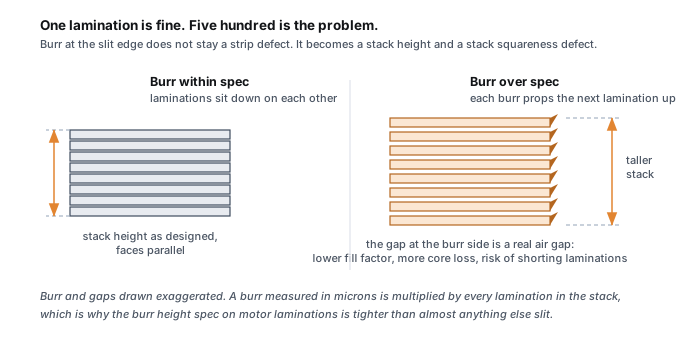
In a lamination stack, hundreds of thin sheets are pressed together. The slit edge of every one of them sits against its neighbors. If the burr along that edge is too tall, it does three damaging things:
- It bridges laminations, creating an electrical short between sheets that should be insulated from each other. That short is a path for eddy currents, which are exactly what the thin laminated construction exists to suppress.
- It lowers the stacking factor. Tall burrs hold sheets apart, so more of the core volume is air and less is steel. A lower stacking factor means less flux-carrying iron in the same space, reducing motor efficiency and torque density.
- It creates local heating. The shorted eddy-current paths dissipate energy as heat, which raises core temperature, degrades insulation, and shortens motor life.
This is why a burr that would be cosmetically irrelevant on structural steel is a functional failure on electrical steel. The burr-height limit is not a quality-department preference; it is a magnetic and thermal requirement of the finished motor.
What controls burr height on thin electrical steel
Burr is formed when the cutting edge stops cleanly shearing and starts dragging material. On electrical steel, four things drive it:
- Edge sharpness. A sharp edge shears; a rounded edge folds material over into a burr. Because silicon steel is abrasive, the edge rounds faster than on carbon steel, so blade wear shows up as a growing burr long before the blade looks worn.
- Horizontal clearance. On thin gauge, burr height is acutely sensitive to clearance. Too tight and the strip is dragged; too loose and the edge tears with a large burr. The correct window is narrow and depends on the exact gauge.
- Knife position accuracy. At 0.20 to 0.35 mm gauge, the tolerances that are comfortable on 2 mm carbon steel are no longer comfortable. Small spacer or position errors move the cut into a worse part of the clearance window.
- Runout and vibration. Any eccentricity or chatter periodically changes the effective clearance, and the burr tracks it.
The practical implication: on electrical steel, the moment to change or regrind the blade is set by burr height, not by how the edge looks. Many operations regrind electrical-steel knives on a tight tonnage schedule precisely because the burr creeps up well before the blade appears worn.
Blade selection for electrical and silicon steel
The combination of abrasiveness and a microscopic burr tolerance pushes blade selection toward harder, finer-edged alloys than you would use for general carbon-steel slitting.
| Alloy | Fit for electrical steel | Note |
|---|---|---|
| D2 tool steel | Short edge life | Rounds quickly on silicon content; burr creeps up fast |
| HSS M2 / M35 | Workable | Better edge retention than D2; acceptable on thicker NOES gauges |
| PM HSS (ASP 2030/2053) | Strong choice | Fine carbide holds a sharp edge longer; good burr control over long runs |
| Tungsten carbide | Premium / high-volume | Far longer edge life on abrasive silicon steel; needs a rigid, low-runout line |
For high-volume EV lamination work, carbide is often justified because the abrasive silicon steel would otherwise force frequent regrinds to keep the burr in spec, and every regrind and changeover is lost capacity on a high-throughput line. But carbide only delivers if the rest of the system is tight enough, because at these gauges a chipped carbide edge ruins strip after strip before anyone notices. PM HSS is the safer baseline where the line is not yet held to carbide-grade rigidity. The full alloy decision framework is in our guide to choosing rotary slitter blades.
Edge finish matters as much as alloy here. A precision-ground and lapped cutting edge with concentric grind marks produces a cleaner shear and a smaller burr than a coarsely ground edge, and it holds that condition longer. The rotary slitter blades and knives we manufacture at Maxwell Slitter Industries are ground and lapped to the tight thickness and flatness tolerances that thin-gauge electrical steel demands, in the PM HSS and carbide grades that hold a sharp edge against silicon-steel abrasion.
Tooling tolerance and width accuracy at thin gauge
Electrical steel laminations also carry tight width tolerances, because the slit width sets the core dimension. Two tolerance issues are sharper at thin gauge:
- Stack-up of blade and spacer tolerance. The same cumulative tolerance error that pushes a 2 mm strip slightly out of spec can be a larger fraction of the tolerance band on a narrow lamination strip. Tolerance-controlled blades and spacers keep each strip where the calculation placed it.
- Stripper and separator condition. Thin strip is easy to deform after the cut. Worn or wrong-width strippers and separator rings damage the delicate edge or let strips overlap, which shows up as edge defects in the lamination.
The whole stack (knives, spacers, strippers) has to hold one tolerance standard, because at these gauges the loosest component is magnified into a defect rather than absorbed.
Why calculated setup pays off fastest here
Electrical steel combines a narrow clearance window, a microscopic burr tolerance, and tight width specs, which makes it the material where estimated, operator-dependent setup is most expensive. A clearance that is a little off does not just shorten blade life as it would on carbon steel; it pushes the burr out of spec and risks the magnetic performance of the finished core.
That is why calculated setup has its fastest payback on electrical steel. OptiStack takes the coil width, slit pattern, and material and calculates the side clearance from the actual gauge, selects the spacer combination from your live inventory so each narrow strip lands exactly where the math places it, and prints an assembly sheet the operator builds to. On a line slitting 0.27 mm silicon steel to a 0.02 mm burr limit, the consistency between shifts is the difference between every coil passing and a rejected lot. You can start a free 14-day trial to see your own electrical-steel setup calculated in under 60 seconds, or model the savings with our ROI calculator.
Electrical steel slitting problems and causes
| Symptom | Most likely cause | First action |
|---|---|---|
| Burr above spec, climbing over a run | Edge rounding from silicon abrasion | Regrind on tonnage; move to PM HSS or carbide |
| Burr above spec from the start | Clearance wrong for the gauge | Recalculate clearance for the exact thickness |
| Torn / ragged edge | Clearance too loose, or dull edge | Tighten clearance; check edge sharpness |
| Width out of tolerance | Spacer/blade tolerance stack-up | Use tolerance-controlled tooling; verify the stack |
| Edge damage after the cut | Worn or wrong strippers/separators | Inspect and replace strippers to correct width |
| Wavy / deformed thin strip | Tension or support issue downstream | Check strip support and tension; reduce speed to verify |
For troubleshooting across all materials, see our slitting problems guide, and for how edge quality ties to blade life, our guide to how long a slitter blade edge lasts.
Frequently asked questions
What is the maximum burr height for electrical steel laminations?
For motor and transformer laminations, burr height along the slit edge is typically held at or below 0.02 to 0.05 mm, with tighter limits on high-efficiency and high-frequency designs. A burr above the limit bridges adjacent laminations in the stack, creating inter-lamination shorts that raise eddy-current losses, lower the stacking factor, and cause local heating. The exact limit is set by the motor or core design, but staying under it is a functional requirement, not a cosmetic one.
What blade material is best for slitting electrical (silicon) steel?
Because silicon makes the steel abrasive and rounds an ordinary edge quickly, electrical steel favors harder, finer-edged alloys. PM HSS (such as ASP 2030/2053) is a strong baseline that holds a sharp edge and controls burr over long runs. Tungsten carbide gives far longer edge life on high-volume EV lamination work and is often justified to avoid frequent regrinds, but it requires a rigid, low-runout line. Plain D2 rounds too quickly and lets the burr climb out of spec.
Why does burr height matter so much in EV motor cores?
Laminated cores exist to suppress eddy-current losses by keeping thin steel sheets electrically insulated from each other. A burr that is too tall bridges those sheets, shorting them together and defeating the lamination. The result is higher core loss, more heat, a lower stacking factor (less flux-carrying steel per unit volume), and reduced motor efficiency and life. In an EV traction motor, where efficiency directly affects range, controlling slit-edge burr is a performance requirement.
What clearance should I use for slitting thin electrical steel?
Thin electrical steel needs tight clearance, and burr height is acutely sensitive to it because the gauge is so small, often 0.20 to 0.35 mm. There is a narrow correct window for each gauge: too tight drags the strip and raises burr, too loose tears the edge. Rather than carry over a percentage from thicker material, calculate the side clearance from the actual gauge for every job, since a small error at these thicknesses moves the cut into a worse part of the window and pushes burr out of spec.
How often should I regrind knives slitting electrical steel?
Regrind on burr height, tracked against tonnage, not on how the edge looks. Silicon steel is abrasive, so the edge rounds and the burr climbs well before the blade appears worn. Set a tonnage limit at which burr typically approaches the spec limit for your gauge and grade, and pull the blade at that point. Catching it early keeps regrind stock removal small and total blade life long, and prevents an out-of-spec burr from reaching the lamination stack.
Can I slit electrical steel on a standard coil slitting line?
Yes, but edge quality and tolerance requirements are stricter than general carbon-steel slitting. You will need sharp, wear-resistant tooling (PM HSS or carbide), clearance calculated for the thin gauge, tight blade and spacer tolerances so narrow strips land within width spec, and good strip support so the delicate thin material is not deformed after the cut. The burr-height limit, not throughput, usually sets how the line must be tooled and set up.
Summary
Electrical steel slitting is governed by burr height, because a burr a few microns too tall shorts laminations, raises core loss, and undermines the efficiency the whole laminated design exists to deliver. Hitting the burr limit on thin, abrasive silicon steel takes a sharp wear-resistant alloy (PM HSS or carbide), clearance calculated tightly for the actual gauge, precision tooling that holds width across narrow strips, and regrinds scheduled on burr rather than appearance.
With EV traction motors driving demand for non-oriented electrical steel, the operations that win this work are the ones that can hold the burr spec coil after coil. We can help on the tooling and the setup: talk to us about precision rotary slitter blades and knives for electrical steel, and start a free OptiStack trial to see your clearance and spacer pack calculated for thin gauge before the operator touches the arbor.
Maxwell Slitter Industries has manufactured precision rotary slitter blades, knives, and shimless spacers since 1976 from Rajpura, Punjab, India. OptiStack is our slitting line setup software, used by steel service centers and coil processing operations in 12+ countries.