Quick answer
A rotary slitter blade is defined by six specifications, and you have to get all six right for the cut to be clean and the tooling to last. In order of how often they cause problems:
| Specification | What it controls | How to pick it |
|---|---|---|
| Bore (inner diameter) | Whether the blade fits your arbor at all | Match the arbor shaft exactly; confirm keyway if keyed |
| Outside diameter | Overlap range, regrind reserve, machine clearance | Match the machine's design OD; never undersize a worn set |
| Thickness | Strip-width accuracy and stack position | Hold to ±0.003 mm or tighter for steel |
| Tolerance class | Cut quality and how well the stack holds calculated position | Tighter is a blade-life multiplier, not a luxury |
| Material grade | Wear life and chip resistance for your substrate | D2, M2, M35, PM HSS, or carbide, matched to tensile and abrasiveness |
| Edge geometry | Burr height, edge finish, and cutting force | Square edge for most steel; relieved/beveled for special cases |
The two that get ordered wrong most often are bore (because people assume a "standard" that isn't standard on their machine) and tolerance class (because a loose blade looks identical to a precision one until it is on the arbor). This guide covers all six in the order you should think about them.
Where to buy the tooling in this guide
This page is about specifying a blade, not selling you one. The tooling itself is made by Maxwell Slitter Industries, who have ground slitting line tooling since 1976 and also publish OptiStack. Go straight to the product you need: rotary slitter blades and knives, rubber bonded spacers, precision metal spacers, separator discs, stripper rings or plastic separator shims. For grade choice against your substrate, their knife steel selection chart goes deeper than the summary below.
Why blade selection is a process decision, not a purchasing decision
It is tempting to treat slitter knives as a consumable line item: find the cheapest blade in the right size and reorder it. On a slitting line, that logic breaks down quickly. The blade is the single point of contact between your machine and the customer's edge specification. A blade that is 0.01 mm out of tolerance, made from the wrong alloy for the grade you run, or ground with the wrong edge does not announce itself. It shows up three weeks later as a burr complaint, a torn coil, or a regrind interval that quietly halved.
The right way to choose a blade is to start from the material program you actually run, the machine you run it on, and the edge specification your customers hold you to, then specify the blade backward from there. The rest of this guide is that process.
Specification 1: Bore (get this exactly right or nothing else matters)
The bore is the hole in the center of the blade that fits over the arbor shaft. It is the first thing to confirm because a bore that is wrong by even a few hundredths of a millimeter makes the blade either impossible to mount or loose enough to run eccentric.
- Match the arbor shaft diameter exactly. Common steel-line bores include 75 mm, 100 mm, 120 mm, 150 mm, and 180 mm, but "common" is not "standard": your machine has one correct bore and you should measure it, not assume it.
- Confirm the fit class. A slitter blade is typically a close clearance or light interference fit on the arbor. Too loose and the blade runs eccentric, wearing on one face; too tight and you cannot load the stack.
- Check for a keyway. Keyed arbors require a matching keyway in the blade bore. Keyless (friction-driven) arbors do not. Mixing them up is a common and expensive ordering error.
- Hold bore concentricity tight. Bore concentricity to the cutting edge should be 0.01 mm or better. A blade with a perfect OD but an eccentric bore still cuts on one side.
When in doubt, send your tooling supplier the arbor drawing or a measured shaft diameter rather than a part number off an old blade: old blades drift, and a worn reference bore propagates the error into every new blade you buy.
Specification 2: Outside diameter (overlap, reserve, and machine fit)
The outside diameter (OD) sets how the upper and lower knives overlap and how much material you have for regrinding over the blade's life.
Overlap (penetration) is the amount the upper blade extends past the lower blade. It is driven by the machine geometry and the material gauge. For thin cold-rolled steel, the knives need positive overlap to complete the shear; for thick or high-tensile material, overlap is reduced toward zero or even negative (a controlled gap) so the strip fractures cleanly rather than being dragged. The golden rule from the floor: use the smallest overlap that still gives a complete cut. We cover the exact relationship between gauge, overlap, and side clearance in our slitting machine and knife clearance reference.
Regrind reserve is the practical reason not to undersize. A blade can be reground 4 to 8 times across its life, and each regrind removes a small amount of diameter. If you replace one worn blade in a set with a new, full-diameter blade, the diameters no longer match and the overlap is wrong across the arbor. Buy and regrind blades as a managed set, and track minimum diameter so a blade is retired before it falls below the OD the machine needs.
Two rules:
- Match the machine's design OD, not the diameter of a half-worn blade you happen to have on the shelf.
- Keep blades in a set within a tight OD band of each other so overlap is uniform across every cut on the arbor.
Specification 3: Thickness and tolerance (where strip-width accuracy comes from)
Blade thickness, together with your spacers, determines exactly where each strip lands across the coil width. This is the specification most directly tied to whether your strips come out in tolerance.
Here is the mechanism people miss: tolerances stack. On an arbor with 14 knives, a thickness tolerance of ±0.01 mm per blade can accumulate to roughly 0.14 mm of position error by the last strip, enough to push the outer strips out of a ±0.05 mm width specification on its own, before the spacers have contributed anything. Tighten the blade thickness tolerance to ±0.003 mm and that worst-case stack drops to around 0.04 mm.
This is why thickness tolerance is not the place to economize on a steel line:
- For tight-tolerance steel slitting, specify thickness held to ±0.003 mm or better.
- For general-purpose work at wider width tolerances, ±0.01 mm may be acceptable, but know that you are spending the budget on rework instead of tooling.
- Specify flatness and parallelism too, not just thickness. A blade that is in-spec on average thickness but dished or tapered cuts as if it were out of tolerance.
Specification 4: Tolerance class (the blade-life multiplier nobody quotes)
Tolerance class is the specification that separates a precision rotary slitter blade from a generic one, and it is invisible until the blade is running. Two blades with identical dimensions on the box can perform completely differently if one is ground to ±0.003 mm on thickness, ≤0.01 mm on bore concentricity, and ≤0.02 mm on flatness, and the other is ground to loose commercial tolerances.
The tight-tolerance blade holds the position your setup calculation assumes. The loose one forces the operator to compensate by hand (shimming, nudging clearance, re-running test cuts), and that manual compensation is exactly the variance that destroys both cut quality and blade life. A line running precision-ground tooling against a calculated setup routinely gets 3 to 5 times the life between regrinds that a line running loose tooling set up by feel gets, on the same alloy. The section below on how long an edge lasts puts numbers against that.
The practical takeaway: when you compare blade quotes, compare the tolerance specification line by line, not just the price and the dimensions. Price per blade is the wrong unit. Work it out per ton of slit material instead, and a tighter tolerance class usually wins even when the blade costs more, because it is the thing that stops the operator compensating by hand. The precision rotary slitter blades and knives we manufacture at Maxwell Slitter Industries are ground to those tight tolerances specifically because every downstream discipline (calculated clearance, exact spacer packs, predictable regrind intervals) depends on the tooling holding the position the math expects.
Specification 5: Material grade (match the alloy to the substrate)
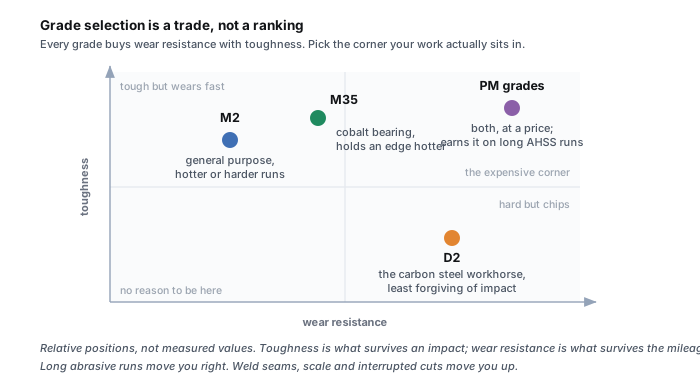
Blade material is where most buyers start, but it should come after fit and tolerance because the wrong alloy on a perfect dimension still fails. Pick the alloy band from the tensile strength and abrasiveness of the material you run most, not the hardest grade you run occasionally.
| Blade material | Typical hardness | Best for | Avoid for |
|---|---|---|---|
| D2 tool steel | HRC 58-60 | General-purpose CR/HR carbon steel, galvanized; the versatile workhorse | High-tensile above ~1000 MPa, fast lines, full-hard stainless |
| HSS M2 | HRC 62-64 | Fast lines and long campaigns where red hardness pays back | Heavy-impact work; harder to regrind well |
| HSS M35 (5% cobalt) | HRC 63-65 | Stainless (304/316/430) and HSLA up to ~600 MPa; mixed-material lines | Over-spec for plain mild steel |
| PM HSS (ASP 2030/2023) | HRC 64-66 | AHSS 780-1000 MPa, full-hard stainless, silicon/electrical steel | Budget jobs on soft grades |
| Tungsten carbide | - | Ultra-high-tensile, electrical steel, lines where blade changes are the bottleneck | Any line with runout, vibration, or operator clearance margin |
A few selection principles that matter more than the table:
- Tensile strength is the primary driver of wear, not gauge. A 600 MPa grade wears a blade 2 to 3 times faster than a 350 MPa grade of the same thickness.
- Coatings are abrasive independent of strength. Zinc, aluminized, and organic coatings round the edge faster, which pushes you up a grade even on soft base metal.
- Carbide only pays back when the whole line is tighter than the blade. It is brittle and unforgiving of arbor runout or spacer drift. On most steel lines the arbor and spacer system is the limiting factor, and carbide shatters long before it wears.
- Specify for the 80th percentile of your program, not the worst grade you ever run. Over-specifying alloy costs money on every blade; under-specifying costs every campaign of the hard grades.
Two material programs deserve their own playbook because they break the general rules: see our guides to slitting advanced high-strength steel (AHSS), where clearance opens up and knives chip rather than wear, and slitting electrical steel for EV motor laminations, where a few microns of burr can fail the core.
Specification 6: Edge geometry and finish
The cutting edge geometry controls burr height, edge finish, and how much force the cut takes.
- Square edge (90°) is standard for the large majority of metal coil slitting. It is the most robust geometry and regrinds cleanly.
- Relieved or beveled edges are used for specific cases: very thin foil, certain non-ferrous work, or where burr direction must be controlled. They are not a general upgrade; a bevel on the wrong application just weakens the edge.
- Surface finish matters for regrind life. A precision-ground and lapped face supports clean re-edging and lower cutting dust. Concentric grinding marks running with the strip path produce a cleaner cut than radial grinds, and the difference shows up within the first few tons after a regrind.
Unless you have a specific reason rooted in your material and edge spec, square-edge precision-ground blades are the right default for steel slitting. Save the special geometries for the applications that actually need them.
Top knives, bottom knives, and stripper rings
A complete slitting setup is not just the cutting blades. When you specify tooling, account for the full system:
- Top and bottom knives are often the same blade specification, but on some machines they differ in OD or edge treatment. Confirm which your machine uses.
- Spacers position the knives and must hold the same tolerance discipline as the blades: a precision blade on a loose spacer stack still lands the strip in the wrong place.
- Stripper rings and rubber separators keep the strips separated and supported after the cut. Worn or wrong-width strippers cause edge damage and strip overlap downstream.
Specify the whole stack to one tolerance standard. The cheapest component in the stack sets the accuracy of the whole arbor.
How to specify a blade when you order: the checklist
When you send a tooling enquiry, include all of the following. A supplier who can quote against this list precisely is one worth buying from; a supplier who only wants a part number is selling you a guess.
- Outside diameter (and minimum acceptable diameter for the set)
- Bore diameter, fit class, and keyway dimensions if keyed
- Thickness with tolerance (e.g. 5.000 mm ±0.003 mm)
- Flatness and parallelism tolerance
- Material grade and target hardness (HRC)
- Edge geometry and any bevel/relief requirement
- Quantity as a matched set, plus regrind/replacement plan
- The application: material(s), tensile range, gauge range, coating, and line speed
That last item matters most. A tooling manufacturer who knows your actual application can recommend the alloy and tolerance band that minimizes your cost per ton, which is often not the cheapest blade. If you want a sounding board on a specific program, the engineers at Maxwell Slitter Industries spec rotary slitter blades and knives against exactly this kind of brief.
How long a blade lasts, and what decides it
Specification and service life are the same question asked twice, so it is worth closing the loop here rather than sending you to a second page. Rough service per edge on cold rolled or hot rolled steel up to about 2.5 mm, before a regrind is due:
| Grade | Order of magnitude per edge | What ends it |
|---|---|---|
| D2 cold work tool steel | Lowest of this list | Abrasive wear, then edge rolling |
| M2 high speed steel | Roughly double D2 | Wear, with better resistance to heat |
| M35 (cobalt HSS) | Above M2 | Wear at higher tensile and higher speed |
| PM HSS, for example ASP 2030 | Several times D2 | Wear, holds an edge far longer before rolling |
| Carbide | Highest by a wide margin | Chipping, not wear. It is brittle and intolerant of runout and stack drift |
Those are ratios, not promises, and they are deliberately written as ratios. Absolute tons per edge depends on your tensile, your gauge, your line speed and your clearance discipline, and a number printed here that did not come off your line is worth nothing on your line. Track your own tons per edge per grade for one campaign and you will have a better figure than any published table.
For grade against substrate, and for what a regrind costs against a replacement, Maxwell cover both in more depth than belongs on a setup page: the knife steel selection chart and their sharpening and regrind guide.
One specification point that belongs here rather than there, because it is a selection decision and not a service decision: every regrind takes diameter off the blade, and diameter is overlap. The outside diameter you order sets how many regrinds you get before the blade can no longer reach the overlap your gauge needs. That is the real meaning of regrind reserve, and it is decided at the purchase order, not at the grinder.
Common blade failure modes (diagnostic reference)
What the edge looks like when it comes off tells you what to change. Most of these point at the setup or the shaft rather than at the blade you bought.
| Failure mode | What you see | Most likely cause | First action |
|---|---|---|---|
| Edge dulling (gradual) | Rolled edge, increasing burr, polished cut face | Normal wear, or material above the grade's capability | Regrind, then reconsider the grade |
| Edge chipping (point defects) | Small notches at varying positions | Impact loads, clearance too tight, hard inclusions in the coil | Recheck clearance against gauge, check coil quality |
| Catastrophic chip | Large piece gone, often with spacer damage | Stack drift, runout above 0.05 mm, or coil end snap back | Pull the tooling, dial indicate the arbor, inspect the pack |
| Glazing (heat damage) | Discoloured shiny band, edge rolled one way | Clearance too tight for the gauge, or speed too high for that clearance | Recalculate clearance, slow the line until verified |
| Radial cracking | Hairline crack running from edge toward bore | A regrind that left subsurface damage, or thermal shock in heat treat | Scrap the blade, audit the regrind source |
| Bore wear | Eccentric edge wear, rising TIR | Spindle runout, journal wear, sleeve problem | Service the shaft. The blade is the symptom |
Note how many of those first actions are clearance or arbor jobs. A blade that chips at varying positions is usually not a bad blade.
The selection is only half the job: the setup is the other half
Here is the part that buying the right blade does not solve. Even a perfectly specified, precision-ground blade underperforms if it is set up by feel. The variables that determine whether the blade you chose actually delivers (horizontal clearance per side, vertical overlap, which spacers go where to land the strip widths, knife orientation for alternating engagement) all have correct answers that depend on the coil width, the slit pattern, the material, and your live inventory.
Calculated against those variables, the setup is reproducible across shifts. Estimated, it varies by 10 to 30 percent depending on who is on the line that morning, and that variance is what eats the blade life you just paid for. This is the gap OptiStack closes: you enter the coil width and slit pattern, and the solver calculates the side clearance from the material thickness, picks the spacer pack from your real stock, and prints an exact assembly sheet for the operator, so the clearance the math wrote is the clearance the operator builds, on every job. You can start a free 14-day trial and watch your own setup come out of the solver in under 60 seconds, or run the numbers first with our free ROI calculator.
Frequently asked questions
How do I choose the right rotary slitter blade?
Work through six specifications in order: bore (must match your arbor exactly), outside diameter (sets overlap and regrind reserve), thickness with tolerance (drives strip-width accuracy), tolerance class (the precision grade that holds calculated position), material grade (matched to your material's tensile strength and abrasiveness), and edge geometry (square edge for most steel). Specify the blade backward from the material program you actually run and the edge specification your customers hold you to.
What size rotary slitter blade do I need?
Size is set by your machine, not by choice. The bore must match the arbor shaft diameter exactly (including keyway if keyed), and the outside diameter must match the machine's design OD so the overlap is correct. Thickness is chosen with the spacer system to land your strip widths. Always measure the arbor rather than assuming a standard, and buy and regrind blades as a matched set so diameters stay uniform across the arbor.
What is the best material for rotary slitter blades?
There is no single best material: it depends on what you cut. D2 tool steel is the versatile workhorse for general carbon steel and galvanized. HSS M2 suits fast lines, M35 (with cobalt) suits stainless and mixed-material work, PM HSS handles advanced high-strength steel and silicon steel, and carbide is for ultra-high-tensile or bottleneck applications but only on a line tight enough to support it. Match the alloy to the 80th percentile of your material program's tensile strength and abrasiveness.
What tolerance should rotary slitter blades be held to?
For tight-tolerance steel slitting, specify thickness to ±0.003 mm or better, bore concentricity to ≤0.01 mm, and flatness to ≤0.02 mm. Tolerances stack across the arbor: a ±0.01 mm thickness error on 14 knives can accumulate to roughly 0.14 mm of position error at the last strip. Tight tolerance is not a luxury: it is what lets a calculated setup hold position, and it makes blades last longer than tooling set by feel, because the clearance the stack produces is the clearance every strip is cut at against loose tooling set up by feel.
What is the difference between top and bottom slitter knives?
On many machines the top and bottom knives share the same specification, but some machines call for different outside diameters or edge treatments between the two arbors. The upper and lower knives work together to shear the strip, with the overlap (penetration) between them set by gauge and material. Always confirm with your machine documentation whether your top and bottom knives are identical or differ, and specify accordingly.
Should I buy carbide rotary slitter blades?
Only if the rest of your line is held to tighter tolerances than the carbide itself. Carbide lasts 10 to 20 times longer than HSS but is brittle and intolerant of arbor runout, spacer drift, and vibration. On a line with total indicated runout under 0.02 mm and precision-ground tooling throughout, carbide can deliver a lower cost per ton. On a typical line with any setup margin, carbide will chip or shatter long before it wears, and HSS or PM HSS is the better value.
How many strip widths can one set of slitter blades produce?
A single set of blades and spacers can produce many slit patterns, because the strip widths are set by how you combine the knives and spacers on the arbor, not by the blades alone. The limiting factor is your spacer inventory and how precisely you can build each pocket width. Setup software that calculates the spacer combination from your live stock lets one tooling set cover a wide range of width programs without buying dedicated tooling for each job.
Does the blade or the setup matter more for cut quality?
Both, and they are multiplicative. A correctly specified, precision-ground blade is necessary but not sufficient: it still has to be set up with the right clearance, overlap, and spacer pack to perform. In practice, most cut-quality and blade-life problems on lines that already buy decent tooling come from setup variance, not from the blade. The highest-return improvement is usually to calculate the setup rather than estimate it, then run it on precision tooling that holds the calculated position.
Summary
Choosing a rotary slitter blade is a process decision, not a purchasing one. Confirm the bore and outside diameter so the blade fits and overlaps correctly, hold the thickness and tolerance class tight enough that the stack lands your strips in spec, match the alloy to your material program, and pick the edge geometry your application actually needs. Then specify the whole stack (knives, spacers, strippers) to one tolerance standard, because the loosest component sets the accuracy of the arbor.
Get the specification right and you have given yourself the opportunity for a clean cut and long blade life. The setup is what realizes it. If you want both halves handled, talk to us about precision-ground rotary slitter blades and knives specified to your program, and start a free OptiStack trial to see your setup calculated before the operator ever touches the arbor.
Maxwell Slitter Industries has manufactured precision rotary slitter blades, knives, and shimless spacers since 1976 from Rajpura, Punjab, India. OptiStack is our slitting line setup software, used by steel service centers and coil processing operations in 12+ countries.