Slitting Machines: How Coil Slitting Lines Work
Slitting is a coil processing operation that cuts a wide master coil into several narrower strips. Rotating arbors carry pairs of rotary knives that shear the metal lengthwise as it feeds through, and precision spacers between the knives set each strip width to a specified tolerance.
Line types, anatomy, arbor and shaft specs, knife clearance, buying mistakes, and maintenance, written for operators and buyers.
Last updated: July 2026
Performance Is Defined by Tooling Accuracy
How slitter knives, spacers, and rolls control cut quality and repeatability.
What is a slitting machine?
A slitting machine is a coil processing line that cuts a wide master coil into narrower strips. It feeds the strip through two rotating arbors fitted with rotary knives and spacers, shears it lengthwise to set widths, and rewinds each strip into its own tight coil on a recoiler.
A slitting machine operates as a high-precision production line, transforming master coils into narrower strips. The integrity of the final product relies on the rigidity of the arbor and the setup of key tooling components.
- Rotary Knives
- Precision Spacers
- Stripper Rings & Rolls
*Proper setup minimizes edge wave and burr formation in recoiled strips.
Longitudinal Cutting
Shearing metal lengthwise with rotary knives under controlled tension.
Recoil Tension
Maintaining tight, uniform coils for downstream stamping or roll forming.
Arbor Rigidity
Minimizing deflection for burr-free edges. The foundation of accuracy lies in shaft stability.
What is a slitter?
On the shop floor, slitter is used two ways. It can mean the whole slitting machine, the line that cuts coil into strips. It can also mean the tooling assembly itself, the arbor loaded with knives and spacers. Context tells you which: running the slitter versus building the slitter.
A setup crew that says a slitter needs new knives is talking about the tooling. A plant manager who says the slitter is down means the line. Both uses are correct and common, which is why the same word covers the machine and the arbor build it carries.
What is a slitter machine?
Slitter machine is another name for a slitting machine, a line that cuts a coil into narrower strips. It differs from a cut to length line, which cuts across the width into flat sheets, and from a plain rewinder, which respools a coil without slitting it into multiple strips.
Types of Slitting Lines and Slitting Systems
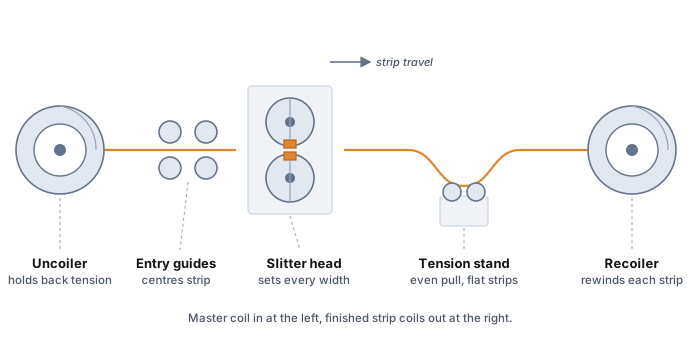
The phrase "slitting systems" means more than the cutting head. A slitting system is the whole line: the uncoiler that pays off the master coil, the slitter head that carries the arbors and tooling, the tension or looping section that keeps the strips flat, and the recoiler that rebuilds each strip into a tight coil. Service centers and tube mills specify a system by four numbers: the gauge range, the maximum coil width, the maximum coil weight, and the number of cuts it must make in a single pass. Buying tooling, or software, without matching the whole system is where most setup problems begin.
Three configurations cover most of the market:
- Light-gauge lines run thin material, roughly 0.15 mm to 2.0 mm, at high speed. They use narrow arbors, thin knives, and rubber-bonded spacers to hold many close strips. Coil weights are usually under 10 tons and cut counts can run past 20 strips in a pass.
- Heavy-gauge lines cut roughly 2 mm to 12 mm and above. They use large-diameter arbors, thick knives, and metal spacers, because rubber compresses too much under the higher separating forces. Expect fewer, wider strips per pass and much larger coil weights.
- Precision and high-speed systems target tight width tolerance, often plus or minus 0.05 mm, on thin stock for stamping, tube, and lamination work. They add close-tolerance tooling, overarm separators, and tension stands so strips do not wander between the head and the recoiler.
Within any of these, the slitter head is either a single-arbor design (knives and spacers built directly on one shaft pair) or a cassette design, where a pre-built arbor set is swapped in and out to cut changeover time. The system you run decides which tooling you buy and how you set clearance, so treat the line, not just the knives, as the unit of decision. For a component-by-component breakdown of what rides on the arbors, see the slitting line tooling guide.
The Slitting Process: Coil to Recoiler
Uncoiler
Master Coil FeedSlitter Head
Critical Tooling ZoneRecoiler
Finished Strips*Schematic representation of a standard precision slitting line. Tooling accuracy at the Slitter Head determines the quality of the entire output.
Anatomy of the Slitting Line
Uncoiler (payoff). The master coil sits on a mandrel that expands to grip the coil bore. A drag brake or motorized payoff holds back-tension so the strip does not slack as it feeds. If the uncoiler cannot keep the coil centered, the strip walks sideways into the knives and width drifts across the coil length.
Slitter head. This is the working zone. Two parallel arbors carry the rotary knives and the spacers that set each strip width. The upper and lower knives overlap by a set depth and sit apart by a set horizontal clearance. Everything that decides width tolerance and edge quality happens here, which is why the head is the part you build with the most care.
Tensioning (looping pit or tension stand). After the cut, the strips need even pull to stay flat and to wind tight. Light-gauge lines use a looping pit that lets the strips hang in a controlled loop between the head and recoiler. Heavier or faster lines use a driven tension stand with pads or rolls. Uneven tension across the strips is a common cause of loose wraps, telescoping, and edge damage on the recoiler.
Recoiler (rewind). Each strip is rebuilt into its own coil on a segmented or expanding mandrel, usually with separator discs or an overarm to keep the strips from climbing over each other. Tension, wrap tightness, and separation quality here decide whether the finished coils ship clean or get rejected for edge wave and loose wraps.
How a Slitting Cut Is Actually Made
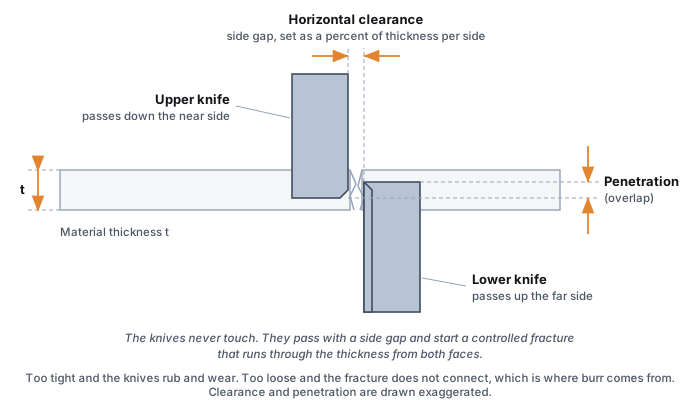
Slitting is not sawing and it is not shearing in a single plane. It is a controlled fracture. The upper and lower knives do not meet; they pass each other with a small side gap (horizontal clearance) and a small overlap (penetration). As the coil feeds through, each pair of knives presses into the strip from both faces, starts a crack, and the metal tears cleanly along that crack. Get the geometry right and the edge looks sheared and bright. Get it wrong and the same machine makes burrs, slivers, or a rough torn band.
Two settings control the result. Horizontal clearance is the side gap between the upper and lower knife faces, set as a percentage of material thickness per side. Too tight and the knives rub, wear fast, and camber the strip; too loose and the crack does not connect cleanly, so you get burrs and edge droop. Penetration (overlap) is how deep the upper knife reaches past the lower knife. Thin ductile metal needs more overlap to start the fracture; thick hard metal needs less. Together these two numbers, plus a sharp edge and a rigid arbor, decide edge quality.
This is also why the same coil can run perfectly one day and poorly the next with no change in material. A knife that has lost its edge, a spacer stack that has drifted a few hundredths, or a shaft that has picked up runout will all change the effective clearance at the cut. Slitting quality is a system property, not a single setting, which is why disciplined setup and tooling records matter as much as the numbers.
Working out spacer widths and knife clearance by hand for a new job? The free calculator does the arithmetic for each pocket in seconds.
Open the free calculatorPrecision in Every Cut
In high-speed slitting, tolerance stacking is the enemy of quality. Any deviation across a set of spacers can result in cumulative error, leading to significant burr generation and knife chipping. Our tooling is ground to rigorous industrial standards to ensure your setup time is reduced and your edge quality is consistent from the first cut to the last.
Defect Analysis & Tooling Causes
| Defect Type | Visual Symptom | Likely Tooling Cause |
|---|---|---|
| Excessive Burr | Rough edge pointing up/down | Incorrect horizontal clearance setting or dull knife edges. |
| Camber (Snake) | Strip curving left or right | Uneven stripper ring pressure or misaligned arbor shafts. |
| Knife Marks | Scoring on strip surface | Stripper rings are wrong diameter (too small) or damaged. |
| Edge Wave | Rippled edges on strip | Excessive overlap setting causing metal deformation. |
Arbor and Slitter Shaft Specifications
The arbor (also called the slitter shaft) is the rotating shaft that carries the knives and spacers. Its job is to hold every knife exactly where you set it while the cut tries to push the tooling apart. When operators talk about a shaft, four numbers matter more than any brand name.
- Diameter. Bigger diameter means more stiffness and less deflection under load. Light-gauge lines often run shafts near 100 mm to 150 mm, heavy-gauge lines 200 mm and up. Every knife and spacer bore must match this diameter, so the shaft size fixes your whole tooling inventory.
- Deflection and runout. Under separating force the shaft bows slightly. Good lines hold total indicated runout to a few hundredths of a millimeter. Excess deflection shows up as width that grows toward the center strips and as burrs that appear only on the widest cuts.
- Keyway or keyless drive. A keyed shaft transmits torque through a key and keyway; a keyless (hydraulic or shrink) shaft grips the tooling all the way around. Keyless shafts hold position better on high-cut-count precision work but cost more and are slower to service.
- Overhung length. The distance from the outboard bearing to the last knife. The longer the overhang, the more the shaft flexes. Keeping the heaviest cuts nearest the bearing, and the largest spacer nearest each knife, is how you fight that flex during a build.
Slitter shafts and arbors are consumable tooling, not fixtures. Keyways wear, journals score, and a shaft that has lost concentricity will never cut clean no matter how sharp the knives are. Track shaft runout on your maintenance schedule and source replacements from a tooling maker who can hold the original tolerance, such as Maxwell Slitter Industries. For how the knives themselves wear and when to regrind, see the guide on rotary slitter blade life.
For the full component breakdown of what rides on the arbor, the tooling guide covers slitter shafts, slitter spacers, ejector rings, and separator discs in detail.
Knife Clearance Quick Reference
Horizontal clearance is the gap between upper and lower knife faces, expressed as a percentage of material thickness per side. Use these guidelines as a starting point, always verify with a test cut.
| Material | Clearance (% per side) | Notes |
|---|---|---|
| Carbon Steel (mild) | 8 to 10% | Standard baseline for most service centers |
| Stainless Steel | 10 to 15% | Higher work-hardening requires wider gap |
| Aluminum | 5 to 7% | Soft material; tight clearance prevents torn edges |
| AHSS / HSLA | 12 to 18% | Extreme hardness; consult tooling supplier |
| Galvanized Steel | 8 to 12% | Coating may flake with excess clearance |
| Copper / Brass | 4 to 6% | Very ductile; tight clearance is critical |
Worked clearance by gauge (carbon steel at 9 percent per side)
Clearance is set by gauge, not just by material family. Multiply the material thickness by the percentage from the table above. These are carbon steel examples at a mid-range 9 percent per side. Thinner gauge needs a proportionally smaller absolute gap, which is why thin stock is far less forgiving of a worn shaft.
| Gauge (thickness) | Clearance per side | Practical note |
|---|---|---|
| 0.30 mm (about 28 ga) | 0.027 mm | Very tight; needs low shaft runout and sharp knives |
| 0.60 mm (about 24 ga) | 0.054 mm | Common light-gauge setting |
| 1.00 mm (about 20 ga) | 0.090 mm | Forgiving baseline for setup training |
| 2.00 mm (about 14 ga) | 0.180 mm | Heavier knives; watch separating force |
| 3.00 mm (about 11 ga) | 0.270 mm | Heavy-gauge; metal spacers, large arbor |
For a per pocket spacer and clearance calculation from your own numbers, use the free slitting calculator. For edge-quality troubleshooting, see the slitting problems guide. For high-strength grades, clearance runs wider; see slitting advanced high-strength steel.
Arbor Setup Best Practices
A well-assembled arbor is the foundation of every good slit. Follow these principles to minimize width variation and edge defects:
- Clean everything, arbor shaft, spacers, and knives must be free of debris before loading
- Fewest spacers per pocket, more spacers means more cumulative tolerance error
- Largest spacer nearest the knife, maximizes rigidity against cutting forces
- Verify with test cut, measure strip widths at 3 points and inspect edge quality before production
- Consider shimless operation, fraction kit spacers deliver tighter tolerances than plastic shims
For a complete walkthrough with load sequences and common mistakes, read our step-by-step arbor setup guide. Need automated spacer selection from your actual inventory? Try OptiStack Pro free for 14 days.
Operator Maintenance Checklist
Daily
- ✓ Inspect knife edges for chips or cracks
- ✓ Clean arbor shafts of debris and metal particles
- ✓ Check stripper ring condition and pressure
- ✓ Verify clamp torque after first cut
Weekly
- ✓ Measure spacer widths for wear tolerance
- ✓ Inspect rubber spacers for compression/cracking
- ✓ Lubricate arbor bearings per OEM spec
- ✓ Check separator disc flatness
Monthly
- ✓ Full spacer inventory audit and re-measurement
- ✓ Verify arbor shaft runout with dial indicator
- ✓ Inspect keyways for wear or deformation
- ✓ Review knife regrind log and schedule
After Regrind
- ✓ Verify new knife OD and bore dimensions
- ✓ Recalculate clearance with updated knife geometry
- ✓ Run test cut and inspect edge quality
- ✓ Update knife inventory in OptiStack
Want to reduce changeover time between maintenance intervals? Learn how service centers cut setup time by 80%.
Common Slitting Machine Buying Mistakes
A slitting line is a ten to twenty year purchase, and the tooling and consumables cost more over that life than the machine did. Most regret traces back to a handful of decisions made before the order.
- Buying for peak gauge only. A line sized purely for the heaviest coil you might run will be clumsy and slow on the thin, high-cut-count work that actually pays. Match the system to the gauge and cut count you run most weeks, not the one job per quarter.
- Ignoring tooling availability. The knives, spacers, and shafts are what you touch every shift. Confirm that precision spacers, fraction kits, and replacement arbors are available and hold tolerance before you commit, or you will be down waiting on a single part.
- No plan for changeover. Ask how long a full tooling change takes on the line as quoted. If it is a manual single-arbor build every time, changeover will quietly eat your capacity. Cassette heads and disciplined spacer management pay for themselves here.
- Underspecifying the arbor. An arbor that flexes will never hold width on the center strips. It is cheaper to buy enough shaft diameter up front than to chase width variation for a decade.
- Treating setup as tribal knowledge. If only one veteran can build a clean arbor, every changeover depends on that person. Documented setups, a spacer inventory you trust, and software that computes the stack remove that single point of failure.
For the tooling questions specifically, the guides on choosing rotary slitter blades and the full slitting line tooling lineup cover what to ask a supplier.
Build every arbor from the stock you already have
OptiStack Pro computes a buildable spacer stack and knife layout for each pocket from your real inventory, so setup does not depend on one veteran. Start a free 14 day trial, no credit card.
Start free trialFrequently Asked Questions
What is a slitting machine used for?
How does a slitting machine work?
What determines cut quality in a slitting machine?
What should I check before buying a slitting machine?
What causes burrs and edge defects in slitting operations?
Can one slitting machine handle different materials and thicknesses?
How often should slitter knives be replaced or reground?
How do I calculate the correct knife clearance for my slitting machine?
What is the difference between a slitter and a slitting line?
What is the difference between slitting and cut to length?
How many knives can a slitting arbor hold?
What is a slitting system?
Related Slitting Resources
Technical guides by language
- Español: Línea de corte longitudinal
- Italiano: Linea di taglio longitudinale
- Deutsch: Längsteilanlage
- Русский: Линия продольной резки
- Português: Linha de corte longitudinal
- Türkçe: Rulo sac dilme hattı